Wednesday, May 26, 2010

Colorado Potato Beetles

Back in March I planted Yukon Gold potatoes at the bottom of the lower left bed and Red Cloud Hybrid beets at the top. This weekend I finished off the bed by sowing squash in 2' mounds, tucking some extra eggplant between the mounds. Marigolds fill in the empty spaces to help protect against insects.

potatoes, beets, squash and eggplant

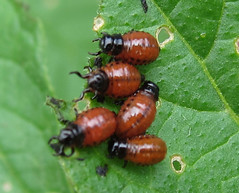
As it turns out, marigolds do not help protect against this nasty insect, the Colorado Potato Beetle, identified at its larval stage by its reddish brown ribbed body, black head, and pair of dark spots down either side of the body.

colorado potato beetle larva

According to every article I've read, the Colorado Potato Beetle is a nasty little bugger that quickly builds up resistance to pesticides and will defoliate potatoes, tomatoes and peppers in a short amount of time. Thankfully, my potato beetles are still in the stage 1 larval period, and have not caused much damage.

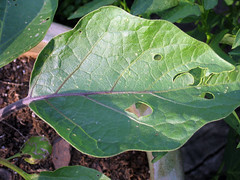
The small holes in the leaves are from flea beetles, which don't eat a whole lot compared to potato beetles. The potato beetles, on the other hand, join forces with their newly hatched siblings to tear down any potato plant in range!

colorado potato beetle larva

They do the most damage in their stage 4 larval form, which I am trying to keep them from reaching. Since I have just a single 10' row of potatoes, manually squashing them to control the population shouldn't be a problem. I'll have to keep an eye on the tomatoes too, because I certainly don't want them setting their sites on other plants!

Labels: , , , ,

Friday, June 12, 2009

Flea Beetles

The flea beetles started early this year, attacking my eggplant seedlings while they were still being hardened off in the seedling tray. Those buggers were impatient this Spring!

The common signs of flea beetles are pin-size holes on the leaves of plants. The bugs themselves are tiny little black specks that could be mistaken for dirt on the leaves. They love the young tender leaves that are just emerging from the plants, and will mow them down in a day if left to their business.

flea beetles

I had to use Sevin on them again this year.

I don't feel so bad about it this year though, as I have been quite fortunate to have avoided pest issues with my other crops. I was in the Tractor Supply Store the other day purchasing a fungicide for the tomatoes when an older gentleman came in asking for Sevin dust. He wanted a big bag of it too. He was wearing office attire, so I knew he wasn't a career farmer, so I asked him what he was planning to nuke with a big bag of Sevin. He told me that he had a large garden and that it was being eaten up by a myriad of insects. His lettuce had been mostly devoured and the radish crop was lost entirely. The bugs were moving in on his warm weather crops and he wanted to save them. I told him of my woes with flea beetles and eggplant and he laughed, saying that eggplant were insect attractors, and if anything was going to get infested, it would be those plants! I felt better knowing that my options were limited with the eggplant and that Sevin was maybe OK in this instance.

I wonder how organic farmers grow eggplant - maybe they use grow tents. That might be a bit excessive for 12 plants in my case, so I guess I'll just keep compromising my principles and spray the buggers down.

Labels: , , ,

Wednesday, July 23, 2008

Growing Eggplant

We planted twelve eggplant plants this year, sown indoors in mid-February. Since we have no experience growing eggplant, we chose eight different varieties in order to find the types that grow best in our soil. We chose the Asian trio from Renee's Garden (which consists of Asian Bride, Little Fingers and Farmer's Long), Italian trio from Renee's Garden (which consists of Rosa Bianca, Beatrice and Nadia), Hansel from Park's Seeds and Lavender Touch from Park's Seeds. I was surprised to learn that there are so many more types of eggplant than the big fat ones you find in the grocery store! The seeds germinated rather slowly, and the seedlings grew even slower, but we did have near 100% success rate with the seedlings. Once transplanted into the garden, the seedlings from Renee's Garden had a higher success rate than those from Park's Seeds. Several of the Park's Seeds seedlings damped off and had to be replaced.

This is how small the plants were when they were first set out into the garden. (The eggplant are in the center of the garden between the lettuce and soybeans.) This was three months after sowing the seeds. We placed paper cup collars over the plants to prevent cutworm injury. Eggplant should not be planted in the garden until night time temperatures remain above 50 degrees since they are very temperamental about cold temperatures, which stunt their growth.
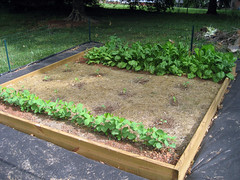
lettuce, spinach, eggplants and soybeans in the vegetable garden

Here is their progress a month later. You can see holes in the leaves caused by the flea beetles.
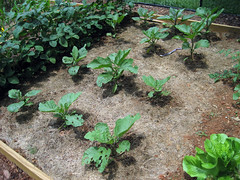
eggplant growing

And here is their present state, finally reaching the height of the soybeans.
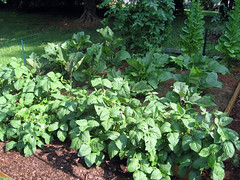
eggplant garden quadrant

I was so excited to see the first eggplant flowers form, as I had no clue where eggplant fruit came from. I have never actually seen an eggplant plant until I planted them myself!
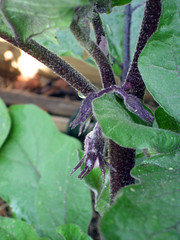
eggplant flower

The thick velvety flowers open to a lovely shade of purple with bright yellow centers. Each of the plants is full of flowers right now. One plant has over twenty flowers on it!
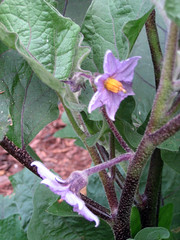
eggplant flower in bloom

Bees work hard to pollinate the flowers, which eventually form fruit, in the same way tomatoes form their fruit.
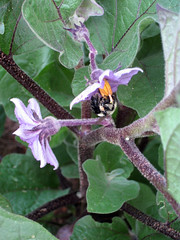
eggplant flower in bloom

Here is our first eggplant fruit! I think it is going to be a Nadia. I was very bad about mixing up the seedlings and not mapping out their final location in the garden, so it will be a surprise when they all start to fruit!
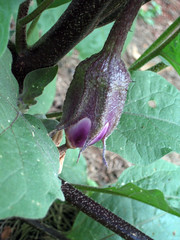
baby eggplant on the plant

Not only are eggplant slow growers and fickle about cold temperatures, but they are very susceptible to flea beetle attacks. When the plants were very small, this was a serious problem, because a couple flea beetles could do a lot of damage to the pair of tender leaves. I did have to spray them with Sevin twice, since the organic spray solutions did not help. Once the plants grew larger and stronger, I stopped spraying. Now I just pick the beetles off the plants in the morning and afternoon. A few beetles won't do much damage to a large plant, so I just keep them under control manually. I hate spraying, but you have to be as persistent as the flea beetles if you are going to control them without spray. I have a lot of respect for organic eggplant farmers after this experience! I can't imagine how they do it.

We enjoy eggplant in numerous dishes; we put them in curry, grill them with olive oil, salt pepper, and roast them in the oven. I am looking forward to trying some eggplant parmesan too! Although it is my favorite Italian dish, we have never tried to make it at home.

Labels: , , ,

Monday, June 23, 2008

Eggplant Woes

Although we are still seeing temperatures in the low to mid 50's during the evening, June 20th was officially the first day of Summer. The garden doesn't seem to mind the cool nights, since they are offset by moderate days filled with warm sunshine and an occasional breeze. Thankfully the skies have been generous these past couple weeks, which has allowed me to give the garden hose a needed rest. All the crops are sown, and the garden is now in maintenance mode. Bring on the harvest!

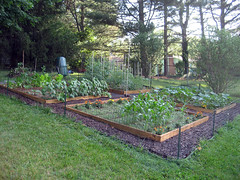
garden view late spring

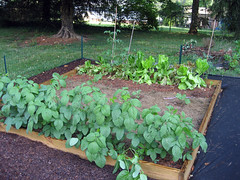
This bed holds soybeans, eight types of eggplant, the remains of the Spring lettuce and three volunteer marcellino cherry tomato plants that sowed themselves from last year's fallen crop. The marcellino volunteers are abundant throughout the garden. I have been picking them out like weeds, but these three were too far along for me to bring myself to snatch them out of the ground. We love tomatoes, and we have a little extra room in this spot, so I let them stay.

eggplant, lettuce and soybeans late spring

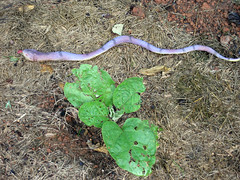
This fake snake helps deter squirrels from digging in the garden. You wouldn't think squirrels could cause much damage, but they will destroy a line of freshly sown seeds by digging around in the soil, and they like to rip up transplants for some reason. (Perhaps this is their way of getting revenge for not being able to reach the bird feeder.) Since I added this snake to the garden, I haven't seen a single squirrel rooting around in any of the beds. It has startled me a couple times too - LOL! You do need to move it around every couple days; otherwise, the squirrels will grow wise that it is a fake.

eggplant and fake snake

A closer look at the eggplant will reveal a series of holes chewed through the leaves. There is a type of insect called a flea beetle that FEASTS on eggplant leaves, and is the culprit here. I never heard of a flea beetle until I planted eggplant, which makes me wonder what they eat when there is no eggplant available. If they were casual munchers who just left harmless holes in the leaves, I would give them cart blanch, but flea beetles are greedy - they will gorge on the plants until nothing remains but a lifeless stick. Would they rather die than eat something other than eggplant, or is the insect communication chain so efficient that every flea beetle in town was notified the minute I set out my transplants? I am frustrated to no end by these insects, but I am also fascinated by the way they find their target crops.

eggplant damage from flea beetles

I have made it a loose rule to not use chemical insecticides on the vegetable crops, but the flea beetles have forced my hand. I love eggplant fruit. They love eggplant foliage. If I do not keep them from eating the foliage, I will not get to eat any fruit. I tried my organic spray for the first four weeks, but I think the flea beetles liked the taste of it, because their numbers only increased. I finally resorted to Sevin. You can only apply Sevin four times during the growing season; otherwise, nasty residue builds up in the soil that causes damage to future crops. I have applied the Sevin twice already, but the flea beetles keep coming. I have resorted now to picking them off several times a day. It's a good thing I work from home.

One variety of eggplant seems resistant or possibly less tasty to the flea beetles since it has far less holes in it than the others. Since I lost track of which type I planted in which space, I will have to wait until harvest to identify the plants. As long as the fruit is good, I will be sure to plant more of these resistant varieties next year and possibly omit the least resistant from the line up.

Gardening is one of the few disciplines where, even if you do the same thing every year, you will learn something new. The ecosystem around us is constantly changing, and the growing conditions are never exactly the same. It's best to just be flexible, never be surprised by anything and have a good time learning something new (even if it is a tragic lesson).

Labels: , , , ,