Wednesday, June 24, 2009

Exotic Weed

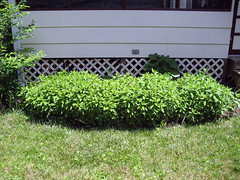
Last year when we found the gold mine of compost in our backyard, it brought with it a stubborn weed that I have been fighting for two seasons now.

Behold - Purslane.

purslane weed

At first I thought it was jade, so I let some of it grow among the corn. Its thick succulent leaves resemble jade, and I thought maybe someone tossed a dying Jade plant into the compost heap and a root cutting was somehow brought back to life.

But then it started multiplying, and I knew it couldn't be something good.

When it reappeared this year, I sensed some major trouble. My suspicions were confirmed the first time I hoed it all out of the garden, because every time I hoe it, it multiplies! It apparently thrives on torture!

A little research on purslane has revealed that the plant hails from India, where the leaves are eaten in salads, stir fry and soups. It is known to be high in vitamins and Omega-3 fatty acids and is used as a medicinal herb for urinary tract conditions.

However interesting that might be, it's a weed to me, and I want it gone. My research has also revealed that you have to remove the entire plant - roots and all, to eradicate it. Otherwise, the roots actually produce seed and the plant continues to propagate! Ah! I guess I'll be down on my hands and knees scrubbing the soil of purslane weeds this weekend.

I showed this weed to my mother-in-law this weekend and she told me that in Honduras purslane is a house plant. When she was there this past April on a missions trip, one of the ladies that works at the orphanage tried to get her to take a purslane plant home with her to the US. Thankfully airport security confiscated it, or she would have a yard full of it now too!

Labels: , , ,

Tuesday, June 23, 2009

Feeding the Tomatoes

Happy Summer! The garden is busy soaking up the sunshiny rays and enjoying the daily showers that have been granted us these past few weeks.

garden view early summer 2009

The tomatoes have made it past the worst of the early blight, probably since I am spraying them weekly with a fungicide and removing infected leaves daily. I have it down to a manageable state, and for that I am thankful. Although rain is great for their roots, it's awful for blight, so when I do have to water, I lug the watering can up to the garden to keep water from splashing onto their leaves. No more overhead watering for me, which is a bummer, because I love listening to the rhythmic patter of the sprinkler in the morning. The forecast is sunny and dry this week, so I'll be building up some arm muscles with all that water lugging.

tomato garden bed

I love the fuzzy beginnings of tomatoes.

tomato flowers

And those cute little green babies. They seem to take forever to ripen, but once they start, we'll be full up on tomatoes for the rest of the Summer!

early tomatoes

When it comes to feeding tomatoes, I like to use two organic products; a granular fertilizer produced by Garden Tone, and a liquid fish fertilizer. Tomatoes are heavy feeders, and I have found that this combination works to keep them happy and vigorous. I prefer organic fertilizers, because not only are they all-natural, but they contain micronutrients and trace elements not found in their chemical counterparts.

The Garden Tone fertilizer is readily available at stores like Lowe's and is quite affordable for being organic. I sprinkle 1/3 cup around each tomato once a month and gently work it into the soil with a garden claw. I always water the plants immediately after fertilizing so the nutrients soak into the soil. This is a mild fertilizer, so don't worry about burning the plants.

You might have to search a little harder locally to find fish fertilizer. I get mine from a "Mom and Pop" seed store out in "the country." Buy it by the gallon, and don't get it from a specialty plant store, or you're going to overpay. Jesse Israel is charging $12 for a quart, whereas I can get a gallon for $20 at the seed store. That gallon will easily last me the entire growing season. Fish fertilizer is pretty darn stinky, but as you use it, the smell becomes endearing. Well, it has for me at least, but I like the smell of manure too, so maybe I'm weird in that regard. Norman (our Pug) goes crazy for fish fertilizer and tries to lick the bottle whenever I am using it. I guess he likes stinky things too! I use it every three weeks at a rate of about 1/4 cup to two gallons of water. This feeds about eight plants, depending on how generous I am feeling that day.

I will also crush up egg shells as we use up all the eggs in a carton and work them gently into the soil around the tomatoes, preferably when the plants are just starting to set fruit. Egg shells provide calcium to the soil, which prevents blossom end rot. The Garden Tone fertilizer contains calcium, but I like to give the plants a little extra boost.

It's not all that much work - just two feedings per month. I wish the weeds were as easy to deal with!

Labels: , , , ,

Thursday, June 18, 2009

It's Not Tacky - It's European

I created this potted flower arrangement with purples, yellow and reds. I wasn't so pleased with my decision to combine red and purple. It seemed rather tacky to me.

planter with purple yellow and red

But then my friend Hillary, who has been to Europe, informed me that it is a very "European" inspired arrangement. That's cool, right? I like Europe.

petunias, verbana and lantana

Regardless of my feelings for this grouping, I love this lantana. It opens orange and yellow.

red orange and yellow lantana

And matures to red.

red lantana

Pretty cool. The foliage of lantana has a pleasant citrus scent. I just love it, and so do butterflies!

Although petunias are not my favorite flower, they do provide lush vibrant color all summer when dead-headed regularly. The foliage is oddly sticky and gives off a light sweet scent. To dead-head petunias, you need to pinch off the entire flower head, not just the flower portion. If you don't dead-head annuals, they won't bloom as vigorously, because they think they have accomplished their task of reproducing. Removing the seed pod causes them to try to produce more seeds; ie, flowers.

petunias and verbana

Strawflower is great for potted arrangements, because it is drought tolerant. The paper-like flowers close at night and during rain and persist for many weeks without the requirement for dead-heading.

petunias and strawflower

So that's my European arrangement! It was totally intentional :)

Labels: ,

Monday, June 15, 2009

Bloomin' Hydrangeas!

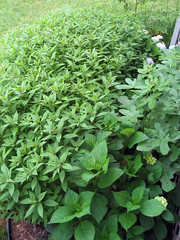
I'm so excited that the Hydrangeas I planted two years ago are finally blooming. I was reckless in planting them in afternoon sun, but that's where I wanted them to be, so that's where they went.

When the gooseneck loosestrife exploded this Spring and hid the plants almost completely, I was worried that they would get crowded out and suffocate.

loosestrife, hydrangeas and hollyhook

As it turns out, the hydrangeas love the shade that the loosestrife have provided and are putting on a lovely show in return.

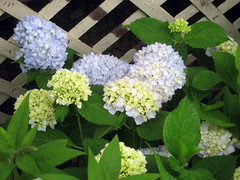
The Penny Mac surprised me with beautiful blue poms.

penny mac hyndrangea in bloom

The Woodlander and Nikko Blue are just starting to bud out, but I will get photos as soon as the flowers open more.

Labels: , , ,

Friday, June 12, 2009

Flea Beetles

The flea beetles started early this year, attacking my eggplant seedlings while they were still being hardened off in the seedling tray. Those buggers were impatient this Spring!

The common signs of flea beetles are pin-size holes on the leaves of plants. The bugs themselves are tiny little black specks that could be mistaken for dirt on the leaves. They love the young tender leaves that are just emerging from the plants, and will mow them down in a day if left to their business.

flea beetles

I had to use Sevin on them again this year.

I don't feel so bad about it this year though, as I have been quite fortunate to have avoided pest issues with my other crops. I was in the Tractor Supply Store the other day purchasing a fungicide for the tomatoes when an older gentleman came in asking for Sevin dust. He wanted a big bag of it too. He was wearing office attire, so I knew he wasn't a career farmer, so I asked him what he was planning to nuke with a big bag of Sevin. He told me that he had a large garden and that it was being eaten up by a myriad of insects. His lettuce had been mostly devoured and the radish crop was lost entirely. The bugs were moving in on his warm weather crops and he wanted to save them. I told him of my woes with flea beetles and eggplant and he laughed, saying that eggplant were insect attractors, and if anything was going to get infested, it would be those plants! I felt better knowing that my options were limited with the eggplant and that Sevin was maybe OK in this instance.

I wonder how organic farmers grow eggplant - maybe they use grow tents. That might be a bit excessive for 12 plants in my case, so I guess I'll just keep compromising my principles and spray the buggers down.

Labels: , , ,

Thursday, June 11, 2009

Vole Hole

I planted this rock garden three years ago and have been fighting with a vole over it ever since. The rock garden is really more attractive than it looks in this photo - it's quite unphotogenic.

norman with rock garden

See the little holes the vole likes to make in the soil.

vole hole

I wouldn't mind a little hole here and there, but he also eats the roots of my plants and tears the site to pieces. What does he do with all that soil? I have to replace 1/3 of it twice a year! Does he eat it? What a weird little critter.

vole hole

I have tried vole repellent spray and granules, but neither have had any affect on his digging. If you've got a vole repellent suggestion that doesn't involve a cat, please do share. I actually had the opportunity to kill this little fellow one time, but he is just so darn cute I couldn't bring myself to do it. I don't mind him chilling in the yard, but he needs to work on his manners!

Labels: , , ,

Wednesday, June 10, 2009

Some Notes on Tomatoes

After sowing the second round of corn to ensure a staggered harvest, the garden is finally filled to the brim.

garden view early June 2009

Gardening is considered a therapeutic hobby, but some of the challenges I faced with the tomatoes this year caused a little more stress than stress relief!

I always grow my tomatoes, eggplant and peppers from seed. This year I bought a seedling heat mat to speed up and increase germination rates and decided to install artificial overhead lighting to keep the tomatoes from getting leggy from leaning toward the window. When you sow seedlings indoors, the seed tray should be subjected to minimal light until the seedlings have broken through the soil. The tomatoes sprung up so quickly out of their warm peat pods that they were leggy from the start, stretching to reach the little bit of light provided from a nearby window while their eggplant and pepper counterparts remained asleep in their seed husks.

So I struggled with the tomatoes to strengthen their thin leggy stems for about 10 weeks. As it turns out, tomatoes aren't big fans of artificial light, especially the Marcellino, most of which were so pathetic looking that I couldn't possibly plant them in the garden. Adding to my frustrations, my attempts at moving the tomatoes around to find the optimal sun spot in the plant room resulted in the seedlings getting all mixed up, leaving me with no clue who was Marcellino and who was Costuloto. I had 10 of each and 16 spots in the garden, so the worst case scenario would end up with only 6 Marcellino in the garden and leave me with less salsa than planned. (I ended up with 7 Marcellino and 9 Costuloto - not bad!)

I did know definitively that a couple of the seedlings were Marcellino and I wanted to be sure to plant those in the garden. In my haste, I accidentally snipped one off in his peat pod, so I had to plunge his tiny little stem into the soil with no roots, hoping it would take hold. It did, but it's now my little runt. Grow little guy! Grow!

runt tomato plant

I decided to try cages this year since staking heirlooms like Costuloto proved a big hassle last year. I planned to stake the Marcellino (keeping them trained to one main stem) and cage the heirlooms since they are impossible to train to one main stem.

By training tomatoes to one main stem, the plant spends less energy producing leafy green branches and more time producing fruit. You get taller plants that are easier to keep staked since you don't have a lot of sprawling branches. My Marcellino generally grow to about 7' using this method.

training tomatoes to one stem

It takes a bit of persistence, but is otherwise simple. Just pinch off the extra branch that sprouts up between the main stem and a side branch. You have to keep on top of this chore though, as those little extraneous branches will keep growing back all season long!

training tomatoes to one stem

Unfortunately, the side shoots of three of the Marcellino got away from me while I was on vacation and now it is too late to keep them trained to one main stem, so I ended up caging them too. I guess we'll see if a Marcellino produces more fruit with one main stem or being treated like an heirloom. Let's not call it a mistake, but an experiment!

After finally getting all those little buggers healthy enough to plant and caging and staking them properly, I was faced with challenge number 3 - early blight.

Two years ago I grew 16 beautiful tomato plants with no sign of any sort of blight or yellowing of leaves. No problems with pests - nothing. They were just gorgeous. Last year the tomatoes were hit with tomato leaf roll, early blight and possibly some form of wilt. I chalked it up to not having rotated the planting site. Naughty gardener!

But this year has started off with signs of early blight already - black spots on the lower leaves caused by a fungus that is spread through air and soil.

early blight on tomatoes

Here are the steps to take to protect against early blight:
  • Always rotate crops from one year to the next
  • Avoid overhead watering - I know - it's how God waters, but for some reason, we're not supposed to water like that
  • Keep the lower branches of the plant pinched back to prevent soil from splashing up onto the plant during rainy weather
  • Use a fungicide early and often throughout the growing season
  • Pinch off any branches that have been affected by early blight - they won't get better and will only spread the fungus to neighboring branches
I recommend purchasing the fungicide spray in concentrate form and mixing it up yourself. I used one bottle on 8 plants last night, and once the plants get even more mature, that rate drops to one bottle per every 4 plants, which can get pricey!

The tomatoes may have caused me a bit of heartburn this year, but the crop is worth it. There is nothing as satisfying to a home gardener as a sweet juicy tomato fresh from the garden. I can't wait for July!

Labels: , , ,

Monday, June 01, 2009

Perennials in Bloom

The perennials have burst into bloom, despite the rain's valiant attempt to wash them out.

The coreopsis, verbana and salvia are giving a lovely show, while the daisies, coneflower, and asiatic lilies are preparing to debut their talents very soon.

last year's new perennial bed

Despite my efforts to rip it all out by the roots earlier this spring, the evening primrose is thicker and more lush than ever and is planning a serious explosion of delicate pink flowers in the next week. Don't plant evening primrose if you don't want it everywhere. It's serious about propagation and is uncontrollable, but it fills in nicely between other perennials to give that full "english cottage garden" look.

evening primrose in perennial bed

A couple of early bloomers have already began to integrate with the yellows and purples of the existing blooms.

sunrise coreopsis and evening primrose in the perennial bed

I planted this perennial bed last spring from seedlings I had sown indoors mid-winter. The salvia and verbana did not return this spring, so I had to purchase new plants from the store. I hadn't anticipated them petering out, or I would have sown replacements this winter. The coreopsis, evening primrose, shasta daisies and coneflower have done very well from seed and are highly recommended for this area.

Labels: , , ,

Wednesday, May 27, 2009

Please Stop Raining

It has been raining for the past 5 days. And we're not talking about a pleasant gentle rain that quickly absorbs into the dry soil to nourish it with rainy goodness. No, we're talking torrential downpour that grudgingly pelts tender seedlings to the brink of death and leaves the roses to hang their heads in disgust.

Stupid rain.

At least we're no longer in a drought and my rain barrel is overflowing. On the downside, the eggplant are really ticked off to be bent toward the ground, their leaves covered in mud, and my soybeans keep getting washed out. Mother Nature - Do you know the meaning of the word "moderation?" Get a dictionary lady.

Labels: ,

Monday, May 25, 2009

Buttercups - A Tolerable Weed

Check out these cute little creeping buttercups.

buttercup

They have such happy little blossoms, and their foliage isn't too hard on the eyes either. It's a shame that they're weeds and they try to take over the entire yard, because they're pretty much impossible to eradicate.

Oh well. They're nice window dressing for the rain barrel.

buttercups with rain barrel

When we began working on the back perennial bed three years ago, these buttercups were flourishing beneath the layer of gravel and landscape fabric the previous owners had laid in that bed. I don't think these plants CAN be killed if they survived those conditions. We just try to yank them out as we see their tips emerge from the soil. We'll never be rid of them, but we can try to keep them managed!

Labels: , , ,

Friday, May 22, 2009

Squirrel POW Camp

I'm at war with the squirrels. They have been digging in my squash, and that's not cool. The poor little seeds haven't even had a chance to germinate yet! The squirrels are so audacious that they dug up the seeds, ate the soft center from the pod and left the empty pod laying next to the freshly dug hole.

I hate squirrels.

They have wised up to the old "fake snake" trick, and they're not falling for it this year. Maybe I should get a real snake, or a mongoose. Yeah, I think a mongoose would work.

fake snake to scare away birds and squirrels

My wire mesh tee pees are all busy protecting the corn from birds and squirrels, so they will be no help to the squash this year.

wire mesh tee pees to keep the squirrels out of the seed line

So I had to come up with a new idea to deter squirrels. Check out this combat zone.

squirrel POW camp

Regardless which direction the squirrels try to enter the seed zone, they will get a little stabbity stab courtesy of a bamboo shish-ka-bob skewer, hopefully in the eyeball.

squirrel POW camp

I'll let you know if they work.

I also sprinkled some cayenne pepper around each seedling planting. Hopefully these squirrels aren't Cajun.

Labels: , ,

Wednesday, May 20, 2009

Flower Boxes

Last year I planted perennials in this window box in hopes that they would return this year, but they didn't make it through the winter. Although I loved the look of last year's design, I didn't want to wait for perennials to mature again, so I went with annuals. The snapdragons were a bad choice since they always wilt like freshly picked lettuce in the sun. I don't know what I was thinking - I guess I just like them. I'll find something to replace them eventually, but I'm not sure as of yet what it will be. Also in the line up are purple begonias, bacopa and verbena - nothing all that spectacular this year.

planters

Last year I planted dracanea and coleus in these two cement planters, but I wasn't happy with those choices. The colors were too dramatic for this area, particularly in harsh contrast with the roses and perennials. I decided to soften this planting up a bit this year with fuchsia, begonias and ivy.

cement planters

Since these two planters are eclipsed by the roses, I had to choose plants that can handle mostly shade.

This firecracker fuchsia makes a nice centerpoint (even though it's not technically in the center).

firecracker fucshia

And the ivy will provide a dramatic draping effect.

ivy

The begonias will fill in the rest of the space nicely, and the curly grass in the back will provide a little bit of contrast for the fuchsia. That's the plan at least!

Labels: , , ,

Tuesday, May 19, 2009

Current Front Yard View

The front yard is coming along nicely. Although the view from the road is not all that spectacular due to the sloping yard, I'm still pleased. The grass is even looking greener this year - too bad it's mostly weeds, but you can't tell that little detail from this photo!

house view

I love the disheveled view down the pathway caused by the perennial bed that was installed last year. The coreopsis is going to town, and I can't wait until those buttery yellow blooms start to open!

pathway view

The curving lines of the new perennial bed help to soften the hard lines of the rest of the yard, and that fresh layer of mulch helps hide its sparseness! This bed will be overflowing with goodness this time next year - hopefully!

new perennial bed

The knockout roses are performing beautifully again.

perennial bed view

This view from the front door has always been one of my favorites.

front porch view

I hope to replace the concrete sidewalk with a stone path eventually, but that is not high on the to do list this year. We'll see what the summer brings!

Labels: , ,

Monday, May 18, 2009

Prairie Petite Lilac

My Prairie Petite lilac has grown so slowly that I suspected it to be a geriatric variety. I purchased it from Park's Seeds in Fall 2007, but from what I can find on their website, they don't sell this variety any longer. I was interested in this plant, because it is supposed to be a miniature lilac but produce blooms as prolifically as a full-size shrub. The intoxicating scent of lilac is a childhood memory that I would like to keep alive, but I don't really have room for a full-size plant in my yard.

In all honesty, I did get a bloom this year, and it smelled fantastic, so I shouldn't complain about the plant, but in even more honesty, this guy was up for composting this year if it didn't bloom.

Here he is first year:

prairie petite lilac

He grew a little bit the second year:

prairie petite lilac bush

And a teeny bit more the third year:

prairie petite lilac year 3

Check out his cute little attempt at blooming.

prairie petite lilac year 3

Poor little fellow. I think I'll give him a little more time to get settled in.

Labels: , , ,

Friday, May 15, 2009

Bleeding Heart on Steroids

I read that white bleeding heart is more difficult to grow than the pink variety, but despite this warning, I wanted to give it a try. I didn't expect much, especially when the plant died back early the first year it was planted.

I was excited to see it emerge last Spring and put on a pleasing display of white heart-shaped arches of flowers.

white bleeding heart

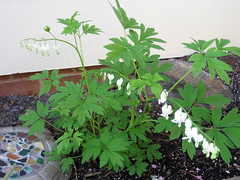
This year was a bit different. The plant SHOT out of the soil and erupted into a volcano of green foliage, interspersed with white shoots of flowers.

bleeding heart year 2

I had no idea bleeding heart reached this size. I wonder if it's the steroids I have been watering into the soil!

Labels: , , ,

Thursday, May 14, 2009

Wisteria Lane

A good friend who lives down the street has an arbor over her back deck that supports the most beautiful purple wisteria I have ever seen.

lauren's gorgeous wisteria

I have always loved wisteria, but after witnessing this spectacle, I decided it is a must-have plant this year. I'm not sure where I will put it, but I have got to get one.

lauren's gorgeous wisteria

The poor thing had been hit by late frosts the past two years and barely bloomed. It is certainly making up for all that lost time this year!

lauren's gorgeous wisteria

Wisteria has a delicate sweet fragrance and attracts bees galore! It is the perfect plant for a gardener who needs to lure bees into her yard to pollinate the squash and tomatoes!

Labels: , ,

Wednesday, May 13, 2009

Gooseneck Loosestrife - Attack!

If we are ever invaded by a foreign army, I have no worries. My gooseneck loosestrife can easily fend them off and keep our home safe.

I transplanted 12 modest twigs of loosestrife from my MIL's garden in Fall 2007. One of the twigs was mowed down by a bunny, and another mysteriously disappeared in the night.

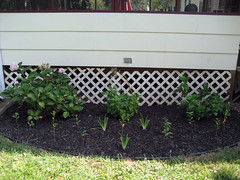
hydrangea garden

I was amazed by how much the plants had filled in the following Spring.

hydrangeas and gooseneck loosestrife

This Spring, I am a little fearful for my yard, as not only has the loosestrife multiplied again, but they are breaking out of their containment area in what looks like an attempt to dominate the neighborhood. I should warn the neighbors. I have little doubt that they could take the cul de sac with minimal effort.

gooseneck loosestrife

My intention was for these plants to fill in this area with a thick lush blanket, and I am overjoyed to see my plan come to fruition in such a short period. If you enjoy the delicate curving heads of gooseneck loosestrife, but fear for your yard's safety, simply cut the bottom out of a large plastic pot, plunge the pot into the ground and plant the loosestrife in that containment area. It will probably keep the plants from spreading ... mostly. Loosestrife is certainly not deterred by poor soil either, so plant it anywhere!

gooseneck loosestrife

I have noticed some people landing on my blog in search of a way to remove gooseneck loosestrife. My suggestion is to dig it up. You would need to completely cultivate the entire area down to 18" to ensure you get all the roots. You won't get them all, but this will be a good start. As you see little baby heads poking back up, plunge your spade deep into the ground around it and extract that bad boy and his roots. I suggest this method over using Round Up although chemicals would be much easier. Please only use chemicals as a last resort. They make the earth cry.

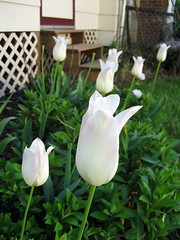
In other news, these pink tulips that are interplanted with the loosestrife turned white this year!

tulips changing color from last year

I suspected that the reason is due to the hybrid bulbs reverting back to their parental form, and my horticulturist / landscape architect / master gardener friend Hillary confirmed that to be true. Pretty cool stuff.

Labels: , , ,