Wednesday, June 09, 2010

Tropical Planters

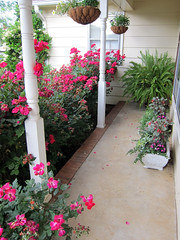
I decided to move the jumbo fern to the far side of the porch this year so guests are not accosted as they try to enter the door. I figure the knock-roses and primrose impede their path enough that if they have to fight past the fern too, they might just give up and turn around. While this is a good plan for people selling meat out of the back of their truck, I would like friends and family to make it into the house, at least when they're invited - LOL!

porch view late spring

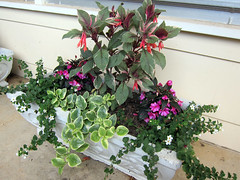
I was really fond of the firecracker fuchsia I found at the Herb Festival last year, and while I intended to dig it up before Winter, my intentions fell short. Thankfully the same vendor offered the variety again this year. Paired with New Guinea impatiens, bacopa and a succulent houseplant, this potted creation has a tropical feel that makes me crave a mojito!

tropical planters late spring

I'd like to find a low profile bench for the porch, where I can enjoy my mojito alongside my little bit of the tropics.

Labels: ,

Thursday, June 18, 2009

It's Not Tacky - It's European

I created this potted flower arrangement with purples, yellow and reds. I wasn't so pleased with my decision to combine red and purple. It seemed rather tacky to me.

planter with purple yellow and red

But then my friend Hillary, who has been to Europe, informed me that it is a very "European" inspired arrangement. That's cool, right? I like Europe.

petunias, verbana and lantana

Regardless of my feelings for this grouping, I love this lantana. It opens orange and yellow.

red orange and yellow lantana

And matures to red.

red lantana

Pretty cool. The foliage of lantana has a pleasant citrus scent. I just love it, and so do butterflies!

Although petunias are not my favorite flower, they do provide lush vibrant color all summer when dead-headed regularly. The foliage is oddly sticky and gives off a light sweet scent. To dead-head petunias, you need to pinch off the entire flower head, not just the flower portion. If you don't dead-head annuals, they won't bloom as vigorously, because they think they have accomplished their task of reproducing. Removing the seed pod causes them to try to produce more seeds; ie, flowers.

petunias and verbana

Strawflower is great for potted arrangements, because it is drought tolerant. The paper-like flowers close at night and during rain and persist for many weeks without the requirement for dead-heading.

petunias and strawflower

So that's my European arrangement! It was totally intentional :)

Labels: ,

Wednesday, May 20, 2009

Flower Boxes

Last year I planted perennials in this window box in hopes that they would return this year, but they didn't make it through the winter. Although I loved the look of last year's design, I didn't want to wait for perennials to mature again, so I went with annuals. The snapdragons were a bad choice since they always wilt like freshly picked lettuce in the sun. I don't know what I was thinking - I guess I just like them. I'll find something to replace them eventually, but I'm not sure as of yet what it will be. Also in the line up are purple begonias, bacopa and verbena - nothing all that spectacular this year.

planters

Last year I planted dracanea and coleus in these two cement planters, but I wasn't happy with those choices. The colors were too dramatic for this area, particularly in harsh contrast with the roses and perennials. I decided to soften this planting up a bit this year with fuchsia, begonias and ivy.

cement planters

Since these two planters are eclipsed by the roses, I had to choose plants that can handle mostly shade.

This firecracker fuchsia makes a nice centerpoint (even though it's not technically in the center).

firecracker fucshia

And the ivy will provide a dramatic draping effect.

ivy

The begonias will fill in the rest of the space nicely, and the curly grass in the back will provide a little bit of contrast for the fuchsia. That's the plan at least!

Labels: , , ,

Wednesday, May 06, 2009

Potted Plants

I started teaching Group Fitness classes last Fall, and I have set aside all my earnings as my "plant allowance." With my first round of allowance, I purchased all new ceramic planters for the back deck. The previous planters were those horrible fiberglass pots that had broken down to the point of uselessness.

potted plants

This pot holds lantana, verbana, petunias, strawflower and decorative grass. It's all very young now, but it will grow bigger and fill in the space nicely.

potted plants

This cute little blue pot holds osteospermum, angelonia, euphorbia. This is my favorite potted arrangement so far.

potted plants

The yellow pot holds lantana, mint, tri-colored sage and verbana.

potted plants

Ian's Aunt and Uncle gave us this birdbath for Christmas. We didn't realize it was a birdbath when we opened it. It looked like a shallow pot to me, and I immediately had a plan that involved succulents mapped out for it. We decided to use it as a birdbath instead though. The birds aren't interested in it, so I think it will get transformed in the future. I don't think they like it being so low.

birbath?

The large blue pot currently holds a big elephant ear that has not yet sprouted. I am planning some other plants for that same pot, but I haven't found what I want yet.

Labels: , , ,

Monday, June 02, 2008

Perennial Flowerbox

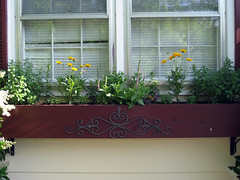
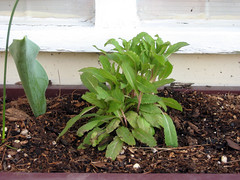
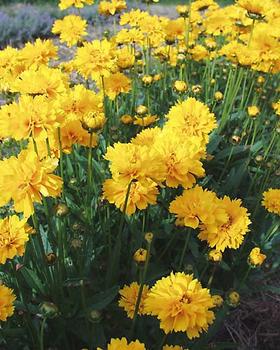
The perennials in the flowerbox are really doing great. The salvia and coreopsis are both beginning to bloom, and the calamintha should be blooming soon. I had to thin out some of the perennials, because seven large plants was a bit too much for the space. I removed two salvia from the sides and left the one in the center. I didn't want the plants to be so crammed in there that there was no room for growth.

perennial flowerbox

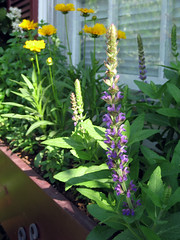
This plant combination reminds me of a miniature wildflower field. I just love it. I especially like the purple / yellow color combination. It really reflects what I consider to be my personal style as a gardener. To me, pastels are "old-fashioned," white is "classic," etc, and although I like a lot of different styles, this flowerbox feels like me.

perennial flowerbox

I mixed in some multi-colored annual verbana and snapdragons for additional contrast, but they haven't been too excited about growing yet. Hopefully they'll find their energy burst soon. I like to mix in annuals, because they add a quick splash of color when the perennials are fading, and I can change them out with each season so the flowerbox isn't static all year long.

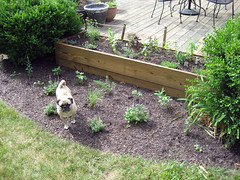
When I reorganized the perennials in the flowerbox, I transplanted the two extra salvia plants to the backyard. I was hoping to deter the dog from launching off the herb box by planting a flower garden in front of it, but he still launches from the box and now pees on the flowers beneath it. Maybe when / if they get taller he will find another place to do his business.

herb box

Labels: , , , ,

Friday, May 30, 2008

Tumbling Tom

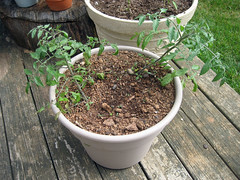
I sowed these yellow tumbling tom tomatoes indoors in February and transplanted them two weeks ago after hardening them off for several weeks. They took off growing from the start!

tumbling tom tomato plants

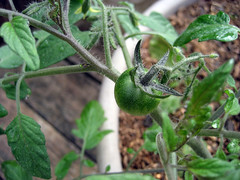
There is already a baby tomato growing on one of the plants.

tumbling tom tomato

When you grow cascading tomatoes, you do not pinch off the extraneous shoots that grow between the main stem and side shoots. When you grow staked tomatoes, you do pinch off these shoots to ensure the plant has only one main stalk. This helps focus the energy toward fruit production and away from producing stalks. This is not necessary with cascaders, because they are not expending energy growing upward, but outward. You want a big bushy cascader filled with fruit!

Labels: , , ,

Tuesday, May 06, 2008

Spring & Summer Containers

Although it rained this past Saturday, I was not deterred by the inclement weather, but managed to get most of my containers planted for Spring and Summer. I gained much inspiration from the Biltmore Estate's beautiful containers and the book Containers from my friend Punchy.

Last year I planted Limoncello Petunias in my hanging baskets. I had grown the petunias from seed, but I was not impressed with the plants or the arrangements. This year I decided to be a little more bold and try to create a Proven Winners arrangement worthy of blogging about. I found a slew of Proven Winners flowers at the Horticulture Society plant sale at the Farmer's Market and chose purple, white and yellow annuals to complement the perennial planting combination in the front flowerbox. The flowers for each basket cost about $14.

Priscilla Supertunia is a lavender double-flowering petunia with dark purple veins. Yellow Chiffon Superbells brings non-stop color from Spring until frost. Giant Snowflake Snowstorm provides lush green foliage dappled with sweet little white blooms reminiscent of strawberry flowers. The plants are still small, but I am confident they will fill out the baskets beautifully by the end of May, especially once I start hitting them with some Miracle Grow once a week. I planted Proven Winners superbells last year in one of my other containers and was happy with the results.
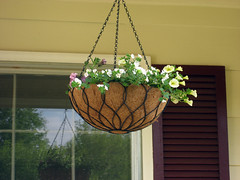
spring hanging baskets

I really like the soft airy flow of these arrangements and the contrast of the dark purple against the yellow and white.
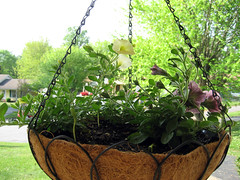
spring hanging basket

As a side note, I could not find adequate replacement coconut liners this year for my hanging baskets and had to purchase new baskets altogether. The only replacement liners I could find in stores are the non-molded flat round liners that look really crappy when you try to cram them in the basket, because they overlap and look bulky and unprofessional. We can't be having unprofessional looking baskets on my front porch! Furthermore, when these liners get wet, they fray and fall apart. In past years, Lowes and other stores have sold the replacement liners that are molded to fit the baskets perfectly. Next year I will buy them on-line!

My smaller side window box is a bit less interesting this year but will serve an important purpose - helping to keep aphids off the roses! I planted yellow coreopsis and orange nasturtium in this box. The coreopsis brings nice height to the center of the arrangement, and the nasturtium will cascade over the sides to provide some additional interest. I love the modeled foliage of these nasturtium. Furthermore, aphids LOVE nasturtium, and I am hoping these plants will act as a decoy to keep aphids away from the roses. I am getting tired of spraying down those roses already, and it's only May! This planting cost about $10 total.
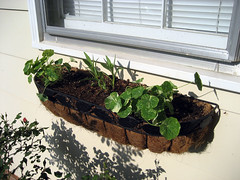
side flowerbox

My two cement planters on the front porch get a little bit of morning sun, but enjoy the cool shade for the majority of the day. In the past, I positioned these planters at the front of the porch, but I decided to move them back against the wall this year since the roses have grown to be so large. I like the new position.
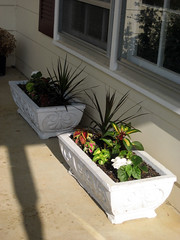
spring flowerbox

I chose white begonias, orange (new guinea) impatiens, (wizard's mix) coleus and draceana for this planting. The begonias will cascade over the side of the box, bringing a full lush display of glossy green foliage and large white flowers. The impatiens will not only provide lovely orange blooms but add some interest with their multi-colored foliage and red veins that helps complement the habit and color of the dracaena. The dracaena (the spikey plant) adds a tall focal point to the planting, and the multi-colored coleus helps tie the colors and varying habits of the other three plants together. All of these plants are still very young and small and will eventually fill in the box to the point of overflowing. I was concerned that these two boxes are too disjointed from the style of the roses and other containers, but I decided I really like this contrast. Continuity is important, but you have to add a little spice to keep people on their toes too! The plants for each of these containers cost about $7.
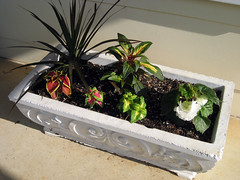
spring flowerbox

The three-tiered planter is sporting calamintha in the top tier, pink and white double petunias in the middle tier and strawberries in the bottom tier. Although we did not get much fruit from our strawberries last year, I just had to try again! Besides, these plants were only $1 each at the Farmer's Market, so I couldn't help myself. The plants for this container cost about $15.
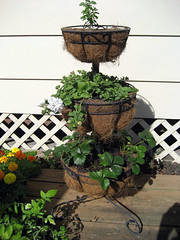
three tiered planter in spring

I also put together an arrangement on the back porch with coleus, sweet potato vine and black elephant's ear, but the elephant's ear bulb has not emerged yet, so the planting is pretty boring to look at.

I had a great time working on these containers and was proud of myself for not spending *too* much money on the plantings. I found some great deals at the Farmer's Market, Lowes and a cute little garden center in Fletcher that I look forward to visiting again soon. I am trying to be economical, but I don't want to trade off quality for value, because poor quality plants are never a good value. Beware of Lowes. Although I do buy some plants there, I do so sparingly when I cannot find what I am looking for at *real* garden centers. There is a noticeable difference in quality between plants purchased from Lowes (or any other department store; ie, Home Depot, Wal-Mart, etc.) and plants purchased from a real garden center.

Labels: , , ,

Monday, April 28, 2008

Perennial Flowerbox

The perennials I ordered from Bluestone Perennials for the front flowerbox arrived a couple weeks ago! I am always happy with the quality of plants I receive from this company, and this time was no exception. The plants were packed beautifully and arrived in perfect condition. Most plants are sold in three-cell packs, and although they are much smaller than plants you would find at Lowe's or other garden centers, the quality is incomparable. From my experience, Bluestone Perennials trumps them all.

East Friesland Salvia:

salvia

Early Sunrise Coreopsis:

coreopsis

Calamintha:

calamintha

A view of the entire flowerbox. (There are some straggler tulips and daffodils mucking up the scene. I know I should just throw them out because they didn't bloom this year, but I have trouble throwing things away. I guess I'm a plant pack-rat!)

window box spring 2008

I will take monthly photos to show how quickly perennials from Bluestone Perennials grow. I'm sure these will bloom the first year too!

I top-dressed the soil with compost to give the plants a little jump start into the growing season. You should never fertilizer newly planted perennials with chemical fertilizers, but always wait 1-2 weeks to avoid damaging their tender roots. It is stressful on a plant to be transplanted, and fertilizing the roots only increases this stress. Also, the plants usually have enough left-over fertilizer from their original potting soil to last a while. Always be sure to water the plants thoroughly and keep them well-watered for the first week while they are adjusting to the new site.

When you purchase plants on-line, always take time to harden them off before planting. This involves setting the plants in filtered sunlight for an increasing amount of time over 2-3 days. The first day, set them out in the morning for an hour or two, then bring them back into a shaded area. Increase this time each day little by little. If cold weather is expected, keep them sheltered in a covered porch or garage overnight. When plants are grown in a greenhouse, they suffer shock if they are transferred to a garden site without gradually adjusted them to outdoor conditions. The sunlight in a greenhouse is filtered and less hot than outdoors. If the plants have not been hardened off, and you plant them immediately into a full sun site, they could suffer irreversible damage. Furthermore, you should plant them on an overcast day or near the end of the day so they have time to adjust to the new site without the added stress of the mid-day sun. When purchasing plants from a garden center, be sure to ask the salesperson if the plants have been hardened off. If the salesperson doesn't know what that means, you probably shouldn't buy plants from that store.
I am definitely becoming a plant snob.
Labels: , , , ,

Friday, February 29, 2008

Planning the Window Box

I get overwhelmed easily. This is true in just about every area of my life. I can sit down and plan a project out for hours or even days, but as soon as I go to the store to purchase the required items, even with list in hand, my head starts spinning at all the options in front of me and I can't think straight. I end up getting the wrong things and forgetting half of what I needed. I think I might be a little retarded, or at least have a slight case of ADD.

This is a real problem for me when trying to plan a flowerbox. There are just too many choices of flowers out there. I get a plan in place, but when I go to buy the flowers, either they don't have what I want and I am unable to amend my idea on the spot, or they have plants that I never considered that look much more appealing than my current plan. Either way, I am not good at changing my plan in a hurry, but when I am at the store, I really want to buy something so I can get the project finished, and I end up making bad decisions.

To avoid this problem while planning the flowerboxes this year, I decided to buy my flowers on-line. This way I can peruse all the flower options and make a much more informed and easy-going decision.

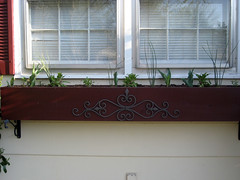
This is the flowerbox I am currently planning. It sits in blistering hot full sun the entire day during the Summer, and I get tired of lugging water to it by mid-August, so my plant selections have to be very hardy in harsh Summer conditions.


I know I want a plethora of flowers filling this box, much in the style of an English cottage garden. Flowers should be towering over the box and sprawling out of it, and it should be cram-packed, but in a good way. I like purple and yellow in this spot, because I think those colors complement the burgundy box and light yellow paint of the house. My latest effort to plan the perfect flowerbox led me to the following plants.

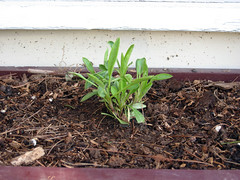
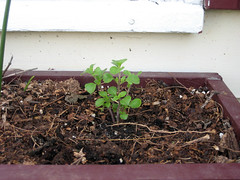
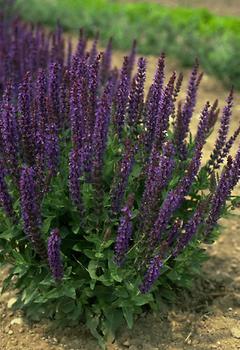
Three clumps of East Friesland Salvia as the strong anchor plants. This perennial will grow to 18" in height and spread to 16". I like the sturdy upright spikes of intense deep purple. This plant is also remarked as being good for containers and disliking wet feet in Winter, which is good, because this container doesn't get a drop of water from me in Winter.


Early Sunrise Coreopsis will provide a rich buttery yellow to the combination and also soften up the bold spikes of the Salvia. Coreopsis LOVES hot dry conditions, so it is well-suited for this spot. I also know from experience that coreopsis blooms non-stop from Summer to Fall, so this plant will provide a constant backdrop for a foreground of changing annuals.


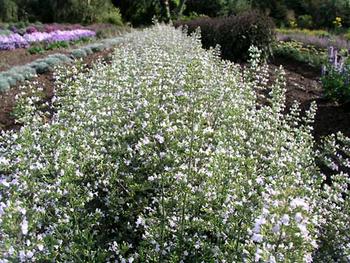
This light and airy Calamintha should soften up the overall look and fill in some of the blank space in the box. This plant is also remarked as tolerating hot dry sites and being suitable for containers.


I also plan to fill in between the perennials with various annuals like:

purple petunias


yellow and white snapdragons


violas


So, this is the plan for now, but I'm sure it will change as soon as I step foot into Jesse Israel's and see their vast selection of perennials this Spring!

Labels: , , , ,

Friday, February 01, 2008

Planning Spring and Summer Containers

We're deep into the Winter months here in North Carolina, and I have been pouring through plant and seed catalogues planning for the coming Spring. One area I plan to focus more attention this year is on my containers. Punchy sent me a wonderful book entitled Containers that has beautiful pictures and great ideas. I look forward to putting that knowledge to use this year. I also got some good inspiration from the Biltmore House this past Summer. I took some photos to use as reference for my own creations.

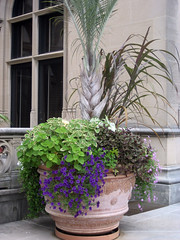
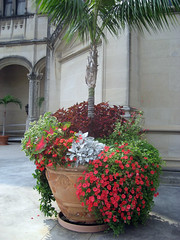
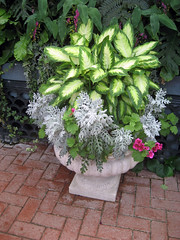
This smaller scale arrangement does a nice job combining the contrasting colors and textures of the silver dusty miller and the two-tone greenery of the center plant. I don't know the name of the center plant, but a hosta or fern would work in its place if you can't find this exact plant. The splash of pink is quite lovely, and could be achieved with any number of different annuals including; cosmos, pansies, petunias or impatiens. Dusty miller can grow to be very tall, so you would need to keep pinching it back to keep it in check.

biltmore planter

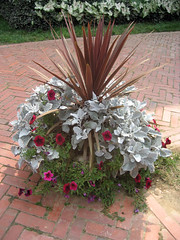
Another smaller scale arrangement that combines contrasting colors and textures to achieve a nice unified balance. You could use a decorative grass or yucca in place of the spikey cordyline as the center plant if you cannot find cordyline. It is usually found in the houseplant section of nurseries. I like the silver artemesia that is used for contrast. There are numerous types of artemesia that could be used depending on availability in your area.

biltmore planter

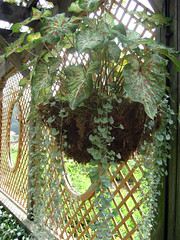
This hanging basket uses caladiums as the anchor plant. What a novel idea. It would need to be placed in a very shady spot and kept well-watered since caladiums tend to wilt quickly in the Summer sun. You can purchase caladiums as bulbs or growing plants at your local nursery. The plant that is spilling over the side is a form of dichondra and is very popular in container arrangements, but it can be hard to find since it sells out quickly. If you cannot find this plant, you could use any type of weeping plant in its place, including; ivy, thyme, periwinkle, sweet potato vine or nasturtiums.

biltmore planter

Biltmore has a spectacular display of very large containers, most of which are not suited for the typical garden, but there are still some interesting elements that can be modified for a smaller container.

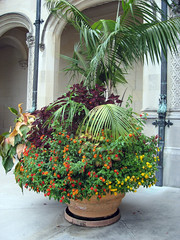
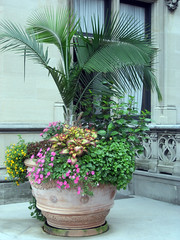
The use of a large potted palm with smaller accent plants is attractive to me. There is a lot of interest in this arrangement, and it keeps the eye moving from plant to plant to create a nice effect.

biltmore planter

Here is a larger palm with an electric blue accent plant, possibly this blue form of Superbells from Proven Winners.

biltmore planter

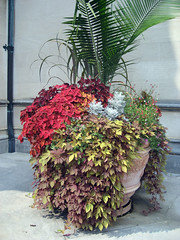
The plants are just jam-packed into this container to provide a nice medley of hot colors and texture.

biltmore planter

This is a softer spin on the previous container arrangement. The designer is still using reds and burgundies, but they are much easier on the eye.

biltmore planter

Lantana gives this arrangement a fuller, bulkier appearance than the previous arrangements.

biltmore planter

I have so many ideas in my head now that there is no way I can put them all into action, but I look forward to trying out some new ideas this year.

Labels: ,

Monday, September 17, 2007

Autumn Baskets

Autumn is really my favorite time of year. I love the crisp cool air, the chilly nights and mornings, and the warm golds, deep reds and brilliant oranges of the decor. I was inspired by the hanging baskets and potted arrangements at the Biltmore House and decided to do something more adventurous with my own Autumn baskets this year. I usually just stuff a mum in the center and call it done, but after my visits to the Biltmore, I just couldn't bring myself to be so mundane this year!

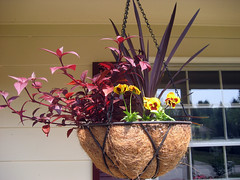
I found some gorgeous burgundy foliage and yellow pansies with complementing burgundy centers at Jesse Israel last weekend. The selection was pretty slim since it is the end of Summer, but the burgundy foliage matches beautifully with the new burgundy growth on the knock-out roses, so I felt pretty lucky to have found these plants. I put together this arrangement for my two hanging baskets.

autumn hanging basket

This was really a stretch for me, because I am generally a very symmetric person, but I absolutely love the asymmetry of this arrangement! The jagged spikes set off the soft scallops of the pansies and other burgundy plant (I can't remember the name) so nicely. I'm proud to have jumped out of my own little box of symmetry and into a new and exciting world of flower design!

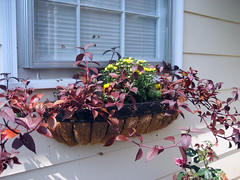
For my side box, I chose more of the burgundy foliage and yellow pansies and added a beautiful yellow mum to the center.

autumn basket

The burgundy plants are tropicals, so they won't make it through the first hard freeze. I'm going to try to overwinter them inside so I can enjoy them again next Autumn. I am running out of "inside" room though!

Labels: ,

Wednesday, August 29, 2007

Limoncello Petunias

I bought a pack of Limoncello Petunias from Park's Seeds to grow along with Chaenarrhinum Summer Skies. I sowed the petunias indoors in March and they finally bloomed in June. They grow very slowly at first, but once they are blooming size, their growth rate speeds up drastically. The germination rate was very low, and the seeds I attempted to sow outdoors did not even pretend to sprout, so if you try these seeds, be sure to sow 3 to a peat pod and don't bother sowing outdoors.

My blooms are not quite the same color as Park Seeds shows. Mine have a greenish center instead of rich yellow as advertised. They have lived up to their blooming hype though, as they have bloomed repeatedly, and the plants are never bare.

limoncello petunia

Here they are 2 months after sowing.

hanging_basket_5_2007

The first blooms appeared 3 months after sowing.

limoncello_bloom_6_2007

Removing spent flowers will keep them in better bloom. I have not been so good about this, because petunias are surprisingly sticky, and I don't like to touch them!

limoncello petunia August 2007

I'm probably not going to sow my own petunias next year, because it was really disappointing. Out of an entire packet of 50 seeds, only 4 plants survived. Those are pretty poor statistics! I am torn though, because I read that a great location to place your tray of sown seeds for germination is on top of the refrigerator. I have been sowing mine in the "spare room." Maybe that room just doesn't offer the best environment for flower seeds. I am going to try the refrigerator method next year, and maybe I will toss a few flower seeds in there just for the fun of it. I guess we'll see what the "winter blues" causes me to purchase from the seed catalogue!

Labels: , ,